DAM Quick Finessa 330
Die Angelrollen-Serie DAM Quick Finessa wurde von 1956 bis ins Jahr 1979 von D.A.M. produziert. Die Entwicklung der verschiedenen Modellreihen im Überblick:
1956-1959: Produktion der ersten Quick Finessa Modelle 280.
1960-1966: Produktion der Quick Finessa Modelle 285.
1967-1972: Weiterentwicklung zur Quick Finessa 110–550 Serie.
ab 1968: Neuentwicklung der Quick Finessa 331 S Schnellgang Serie.
1973-1977: Überarbeitung zur Quick Finessa 110N–550N Serie.
1978-1979: Letzte Ausführung als Quick Finessa de Luxe (220–550P) Serie.
DAM Quick Finessa 330
The DAM Quick Finessa series of fishing reels was produced by D.A.M. from 1956 until 1979. An overview of the development of the various model series follows:
1956–1959: Production of the first Quick Finessa 280 models.
1960–1966: Production of the Quick Finessa 285 models.
1967–1972: Further development into the Quick Finessa 110–550 series.
From 1968: New development of the Quick Finessa 331 S high-speed series.
1973–1977: Revision into the Quick Finessa 110N–550N series.
1978–1979: Final iteration, the Quick Finessa de Luxe (220–550P) series.
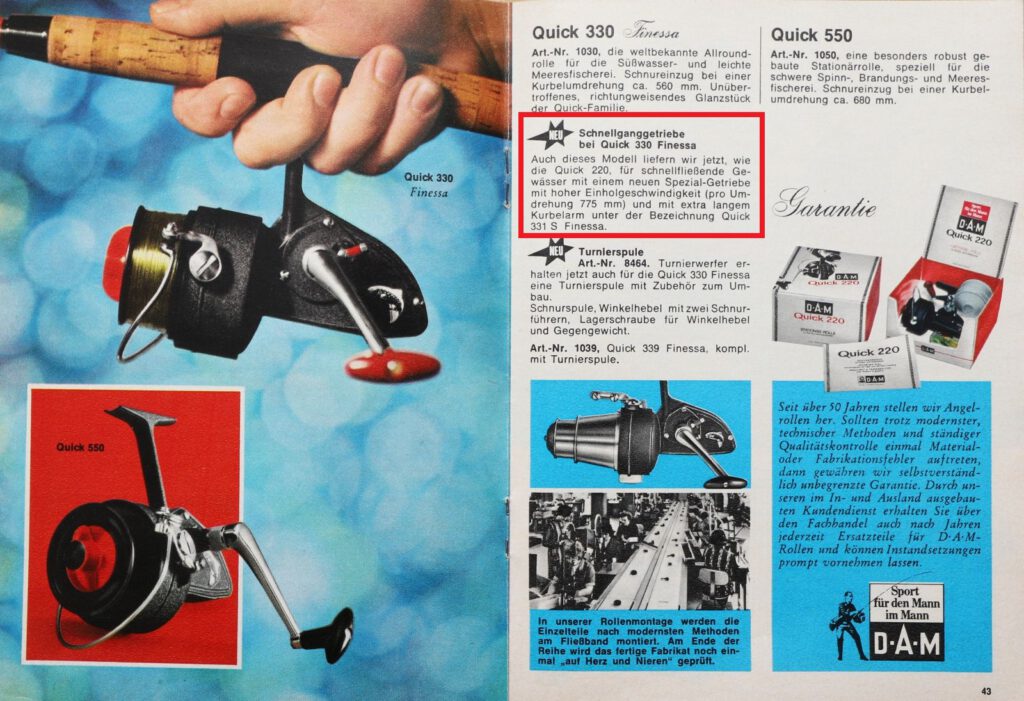
Hier ein Auszug aus dem DAM Katalog von 1968.
Here is an excerpt from the 1968 DAM catalog.
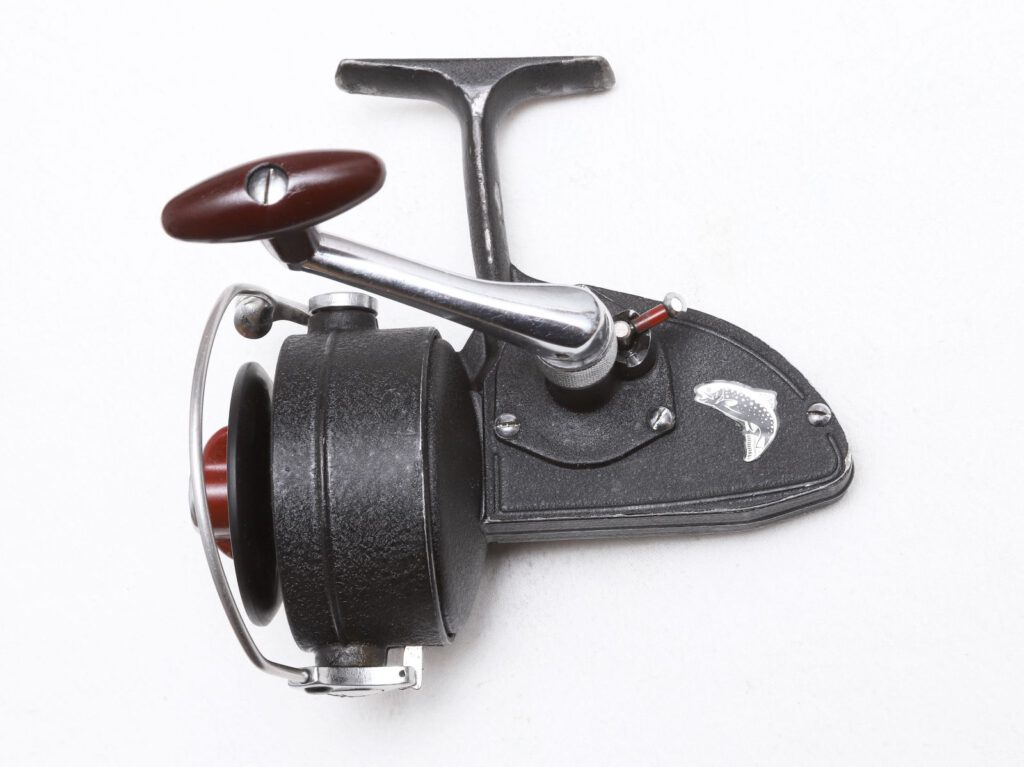
Finessa 330 Version I 1967-68
Gehäuse mit integriertem Rotorblech und noch 4 Schrauben, Fuß große Tasche, beschriftet „Made in West Germany“
Fuß ohne Nr.
Rotorblech Alu Schwarz integriert
Schnecke mit mittlerem Bund, mit offenem Lager und Messing Scheibe als Dichtung und Sprengring als Sicherung
Zinkdruckguss Kurbel mit rotem T Kurbelknauf, Kurbelmutter aus Stahl
Antriebshebel aus Stahl ohne Spritzguss Anschlussstück
Rotor Innen und Außen eloxiert und lackiert, Auslösemechanismus schwarz, Federlager mit Schlitz
Seitendeckel Innen und Außen eloxiert und Außen lackiert, mit 4 Schrauben
Spulenkörper aus Kunststoff, Version I, siehe Bild 10
Rücklaufsperre großer Sechskant Messing vernickelt mit rotem Kunststoff mit 3 Rasten
Übersetzung 1:3,5
Finessa 330 Version I 1967–68
Housing with integrated rotor plate, secured by 4 screws; mounting foot features a large recess and is marked „Made in West Germany.“
Mounting foot (no number).
Integrated black-anodized aluminum rotor plate.
Worm gear with a central collar, featuring an open bearing, a brass washer (acting as a seal), and a retaining ring (circlip).
Die-cast zinc handle with a red T-shaped knob; steel handle nut.
Steel drive lever (lacking a die-cast connecting piece).
Rotor is anodized and painted (both inside and out); trip mechanism is black; spring housing features a slot.
Side cover is anodized (inside and out) and painted on the exterior; secured by 4 screws.
Plastic spool body, Version I (see Image 10).
Anti-reverse mechanism: large, nickel-plated brass hexagonal nut with a red plastic insert and 3 detent notches.
Gear ratio: 1:3.5
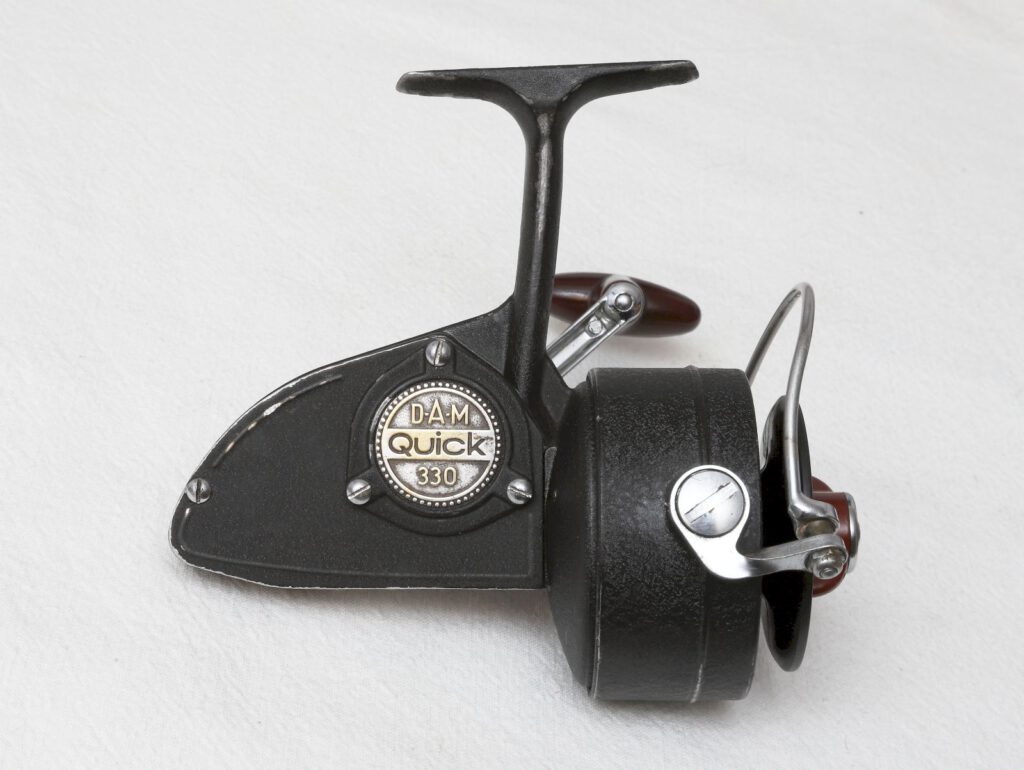
In der Seitenansicht sind einige Gebrauchsspuren, zu erkennen.
Some minor signs of wear can be seen in the side view.
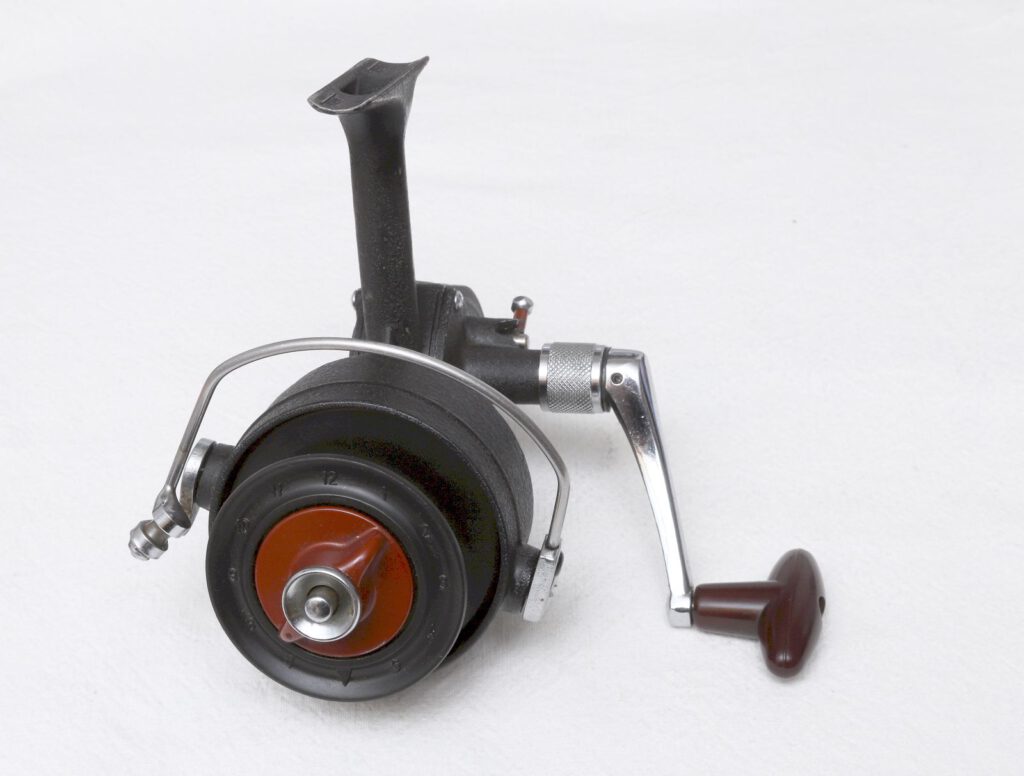
Auch hier sieht man die Zinkspritzgusskurbel und die Kurbelmutter aus Stahl, allerdings jetzt mit einem roten Kurbelknauf und nicht mehr wie bisher, mit einem schwarzem.
Here, too, one can see the die-cast zinc crank and the steel crank nut, though now with a red crank knob, rather than the black one it had previously.
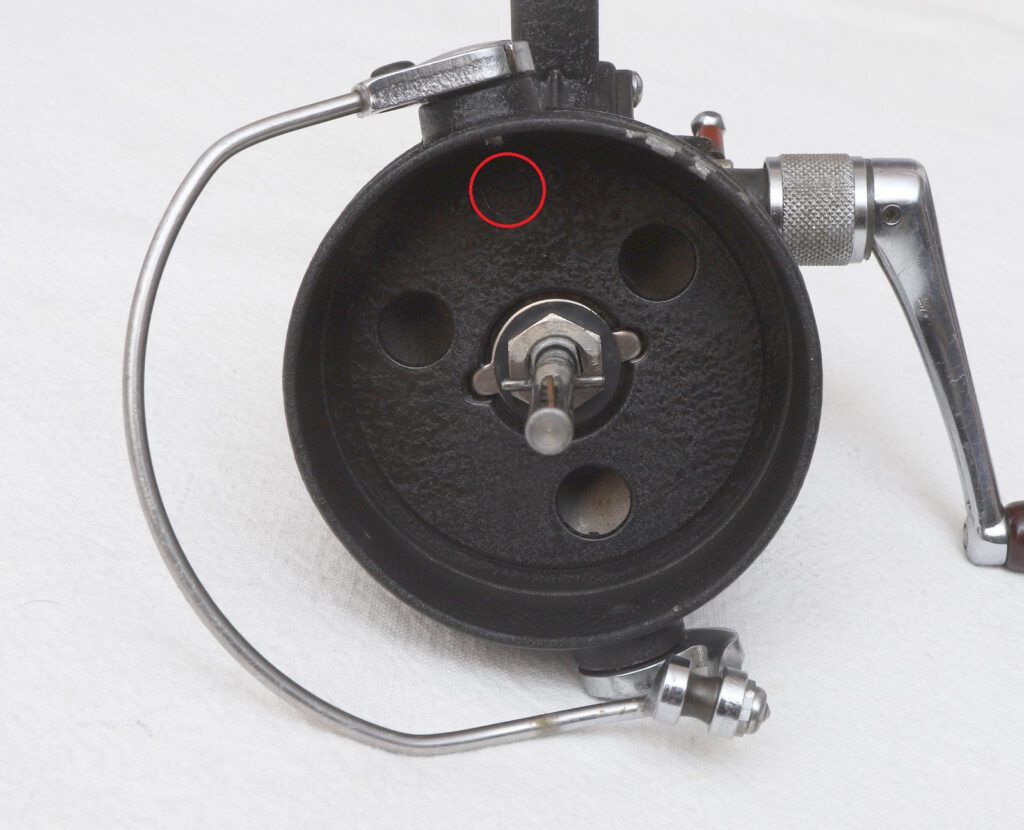
Hier deutlich zu erkennen der Rotor ist innen lackiert, aber der Halter vom Auslösehebel ist nicht mehr blank, sonder er wird jetzt vor dem lackieren montiert.Und er ist kaum noch zu erkennen, denn er ist jetzt auch mit schwarzem Raulack überzogen. Man hat wohl aus Optimierungsgründen, die Reihenfolge der Rotor Montage geändert?
It is clearly evident here that the rotor is painted on the inside furthermore, the mount for the release lever is no longer left bare, it is now installed prior to the painting process. It is also barely discernible, as it is now covered with the same black textured paint. It seems the sequence of the rotor assembly was changed, presumably for optimization purposes.
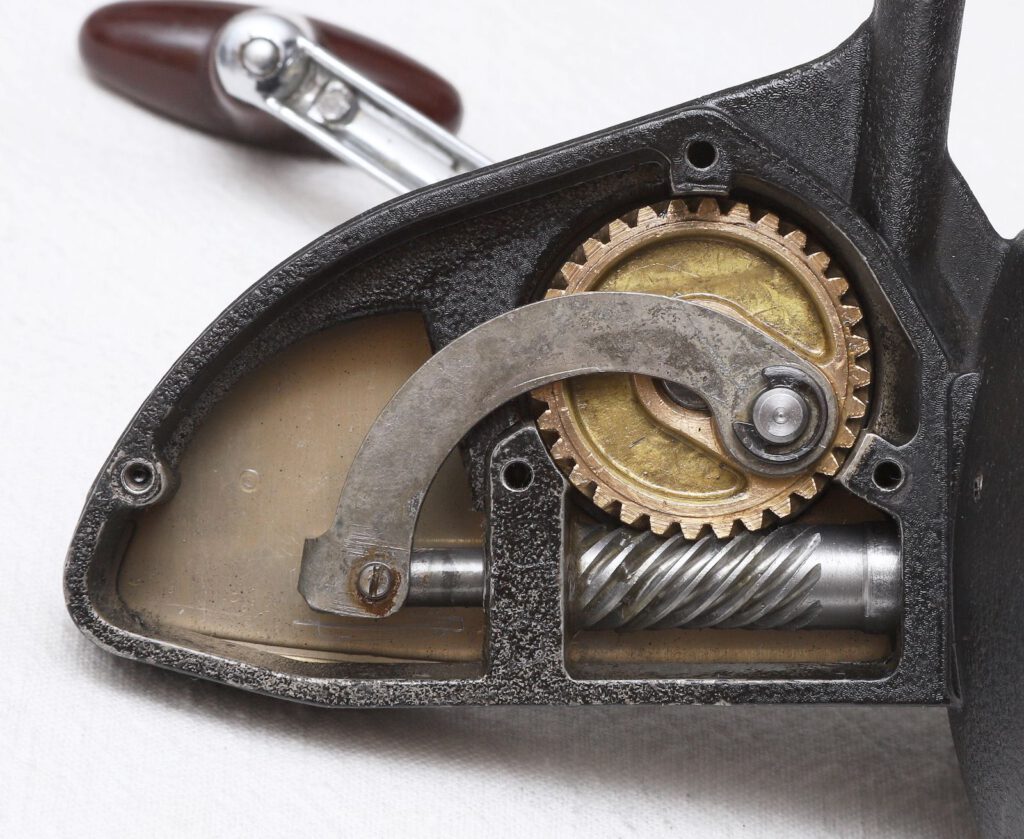
Im 4 Schrauben Modell, der Frühen 330, wurde auch noch der Mitnehmer aus Stahl verwendet.
In the 4-screw model, the early 330, a steel drive dog was still used.
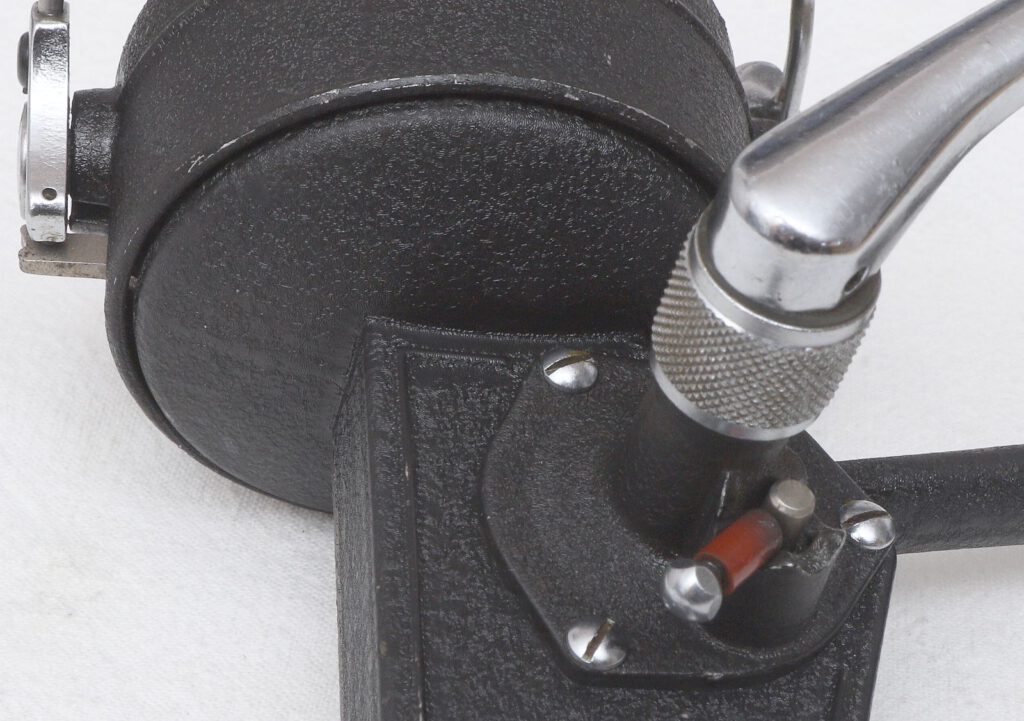
Das Rotorblech ist genauso integriert, wie an den letzten 285er Modellen, das Seitenteil noch nicht.
The rotor plate is integrated in the same way as on the latest 285-series models, but the side panel is not yet.
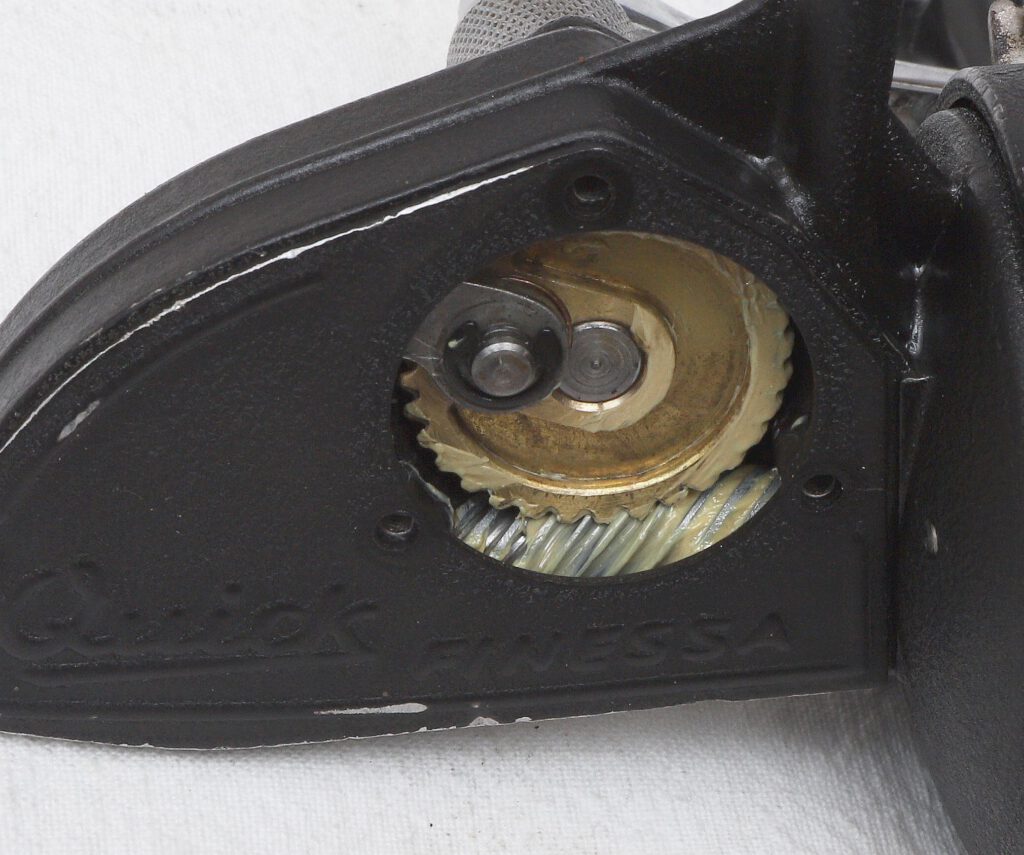
Hier noch ein kleiner Blick durchs Fenster, auf das frische säurefreie Spezialfett.
And here’s a quick peek through the window at the fresh, acid-free special grease.
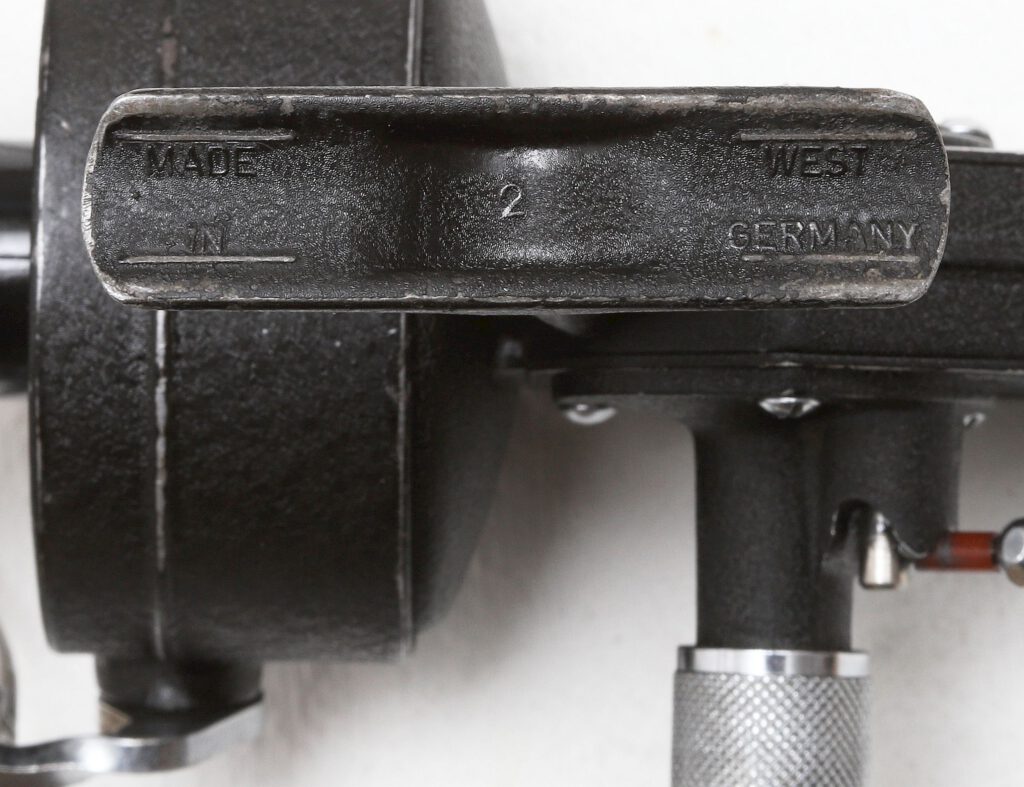
Der Fuß hat auch wieder die große Tasche, aber in der Mitte steht jetzt eine Gussnr. !
The base also features the large pocket again, but now there is a casting number in the center!
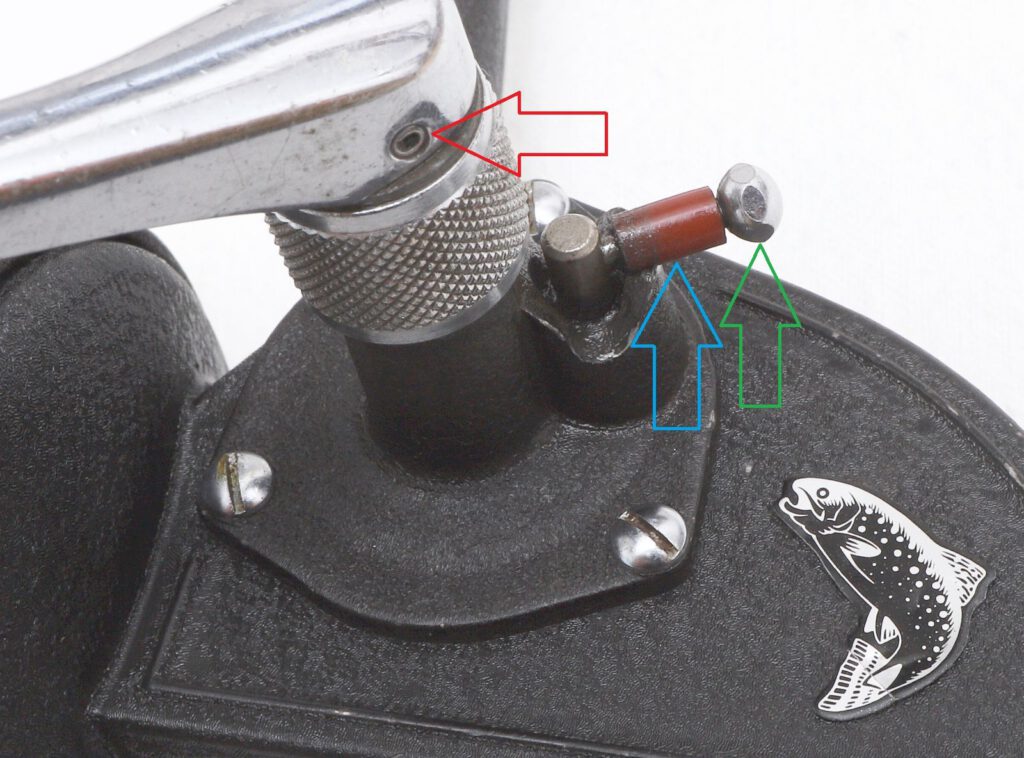
An der Rücklaufsperre gab es jetzt auch ein paar Änderungen, die Schraube (grüner Pfeil) hat jetzt einen größeren Sechskant bekommen und sie ist ab jetzt vernickelt. Die Schraube hat jetzt einen Mantel, aus rotem Kunstoff bekommen (blauer Pfeil), das sollte einerseits die lauten Knackgeräusche, z.b. beim Spinnfischen etwas leiser machen und es war ein Schutz für die Schraube, denn es kam beim sehr häufigen Fischen, mit eingeschalter Rücklaufsperre vor, das sich diese Schraube, soweit abgearbeitet hat, das sie dann beim schalten, einfach abgebrochen ist! Durch die Erhöhung des Durchmessers, durch den Kunststoffmantel, mussten auch die Taschen im Gehäuse größer werden, dadurch kam es, das die Taschen nur noch 3 Rasten hatten, früher waren es 4 Rasten. Außerdem wurde jetzt der Passstift der Kurbel (roter Pfeil) geben einen Federstift ausgetauscht. Der sollte sicher stellen, das bei unsachgemäßer und grober Handhabung, der Passstift nicht nicht mehr verbog oder sogar nach hin und her biegen, abgebrochen ist! Aber er verformt sich Stark und bekommt viel Spiel, siehe Foto 11!
There have also been a few changes to the anti-reverse mechanism, the screw (green arrow) now features a larger hexagonal head and is nickel-plated. The screw has also been fitted with a red plastic sleeve (blue arrow). This serves two purposes, it helps dampen the loud clicking noises, often heard during techniques like spin fishing and it acts as a protective layer for the screw itself. Previously, with frequent use of the anti-reverse, the screw could wear down to the point where it would simply snap off when engaged. Because the plastic sleeve increases the screw’s diameter, the corresponding recesses in the housing had to be enlarged, consequently, these recesses now feature only 3 notches instead of the original 4. Furthermore, the handle’s locating pin (red arrow) has been replaced with a spring pin. This change ensures that the pin will no longer bend, or eventually break off from repeated flexing, if the reel is handled roughly or improperly. However, it deforms significantly and develops a lot of play, see photo 11!
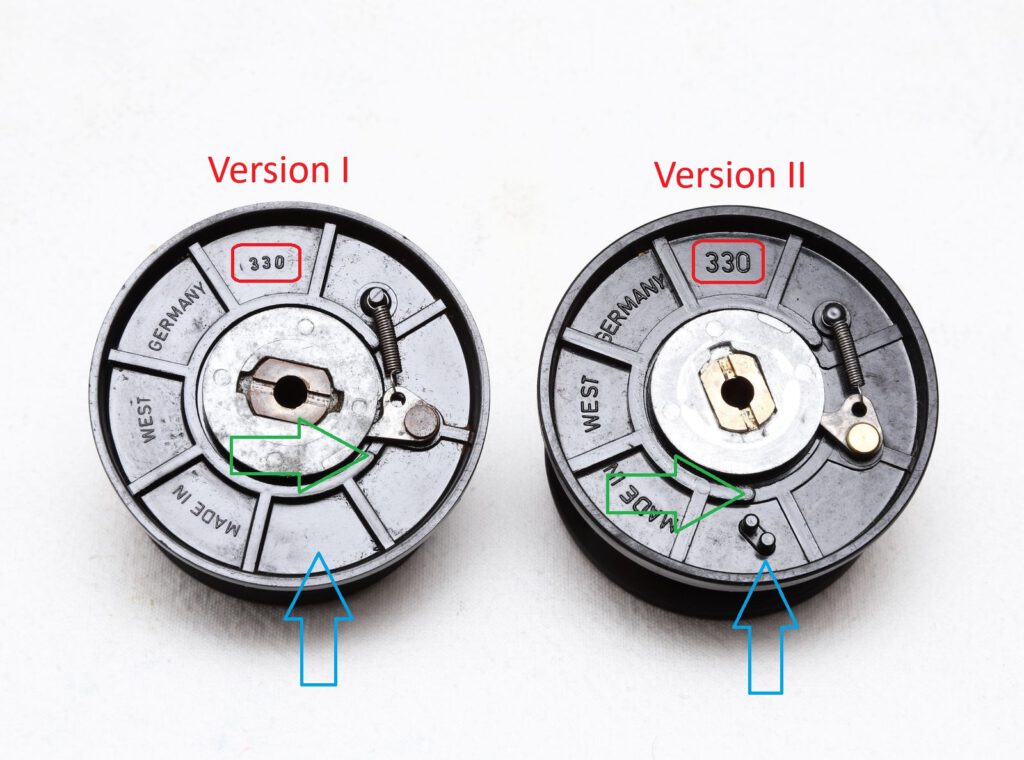
Diese Rolle hat Spule Version I und zum Vergleich auch nochmal die Version II.
This reel has the version I spool, and for comparison, it also includes the version II spool.